Showing posts with label Apple. Show all posts

2021/12/01

Can a cloth be this clever?

Apple came out with new thing called a "Polishing Cloth" which is a microfibre cloth for cleaning screen, being fruity it comes with a fruity price tag.

So now there's Smart Screen an antibacterial, microfibre smartphone cloth.

Smart Screen box

The cloth comes in a box that is obviously designed for retail as there's a plastic tab at the top with a hole in it suited for hanging on something.

Opening the box was a struggle as the internals are behind a tab that looks like it should be pulled to, but only needs to be slightly moved.

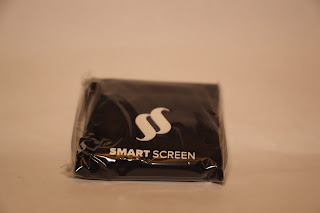
Pouch (wrapped in plastic)


The cloth comes out, but it's encased in a hermitically sealed plastic wrap. Which seems unnecessary since it's sealed in the box in the first place. Ripping that open exposes the pouch holding the cloth.

Smart Screen pouch


The pouch is about 2 inches square and holds the folded cloth which is attached by a piece of material and held by a popper.

Pouch with attached cloth

Then the cloth unfolds

Cloth folded in half

The cloth is impregnated with Blue Shield nano silver particles which (according to the manufacturer) will kill 99% of all bacteria and it will survive 15 washes at 30 degrees.

As a cloth it does clean screens (though it wasn't possible to test the accuracy of the bacterial killing properties).

It only costs £9.95 directly from Smart Screen, though an up market "gold" version is available for £11.50 (or a replacement gold cloth for £4.40). 

Standard colours are Navy Blue, Slate Grey, Powder Blue, Saffron Yellow, Polar White and Camel Brown.

I would guess it's as functional as the fruity equivalent (though never tested that particular cloth).


2017/11/24

The Gemini PDA, it's as close to a Psion as you'll get (and it's real)

Before the iPhone or even Blackberry, there was a PDA made by a company called Psion, well several, eventually culminating in the Series 5. It was a clamshell design with a keyboard on one side and the monochrome screen on the other. It could run applications and it did basic things like had a calendar, calculator and word processor, all driven by a toolbar running along the bottom of the screen. It also had a 'view' screen to see what was happening throughout your life (well days/weeks anyway).

Unfortunately Psion is no more, however a company called Planet Computers is trying to change that and though the actual Psion can't be resurrected, the Gemini is born. The company was set-up by Dr Janko Mrsic-Flogel who used to resell Psion hardware and develop software and has developed a lot of mobile cloud solutions under another company (Private Planet Ltd).

The Gemini looks and feels like a Psion 5

The PDA on the left is an actual working Psion 5 and the PDA on the right the Gemini - they do look remarkably similar. It's worth noting that the Gemini is also running a view screen that emulates the Psion calendar view, giving access to what's coming up in an easy to read manner.

The next picture shows another comparison, but with a lot of test keyboards too.

The various keyboards are for testing different membrane thicknesses and how 'clicky' the keys are. The current thinking is a softer keyboard which will probably appeal more to modern computer users who are used to the light touch, while programmers would probably prefer the keyboard with a deeper travel and more 'Cherry mechanical' keyboard feel (the programmers will probably lose out). But either way, it's perfect possible to touch type on either one.

Underneath the keyboard sits a big battery (removable Li-Ion 4220mAh) giving 12 hours talk-time and a full 2 weeks in standby.

The screen is a 5.99 inch FHD (18:9) with a resolution of 2160x1080 at 403 ppi and full colour. It looks very good. The Gemini doesn't come lightly spec'ed either with: -

  • CPU - Mediatek MT6797X Helio X27 with 10 cores (2 x Cortex A72 @ 2.6GHz, 4 x Cortex A53 @ 2.0GHz, 4 x Cortex A53 @ 1.6GHz
  • GPU - Quad core Mali T880 MP4 @ 875MHz
  • RAM - 4GB
  • ROM - 64GB
  • Sound - Stereo speakers (either side of display)
  • Microphone - integrated behind display and external 3.5mm jack
  • Bluetooth - v4.0
  • GPS - GPS and AGPS
  • USB - 2 USB C ports (OTG support)
  • Camera - front facing 5MP
  • Sensors - accelerometer, gyroscope, compass, magneto-sensor, light sensor
  • SD Card slot - takes at least 128GB, may take 256GB

The Gemini comes in 2 versions, WiFi only and WiFi with 4G. The specs for the 4G model are: -

  • WiFi - 802.11a/b/g/n/ac
  • GSM - 850/900/1800/1900 Mhz
  • CDMA - 850/1900 Mhz BC0 BC1+ EVDO
  • WCDMA - 900/2100 Mhz
  • LTE - 1/2/3/4/5/7/12/17/20/41 and VoLTE

The 4G models has SIM slot (under the top lid) and both have an external camera module space (for a later rear 5MP camera module). There are also 5 fully programmable RGB LEDs on the lid, which can be programmed for fun, but also to light up to indicate, say, who's calling. When the phone rings, it can be operated without ever opening the case.

The Gemini's default operating system is Android (currently 7.1) and it will run many standard Android apps, but in order to make it more Psion like, there's a toolbar at the bottom of the screen that can launch specified apps (as well as using various Psion like key combinations).

There's a dedicated voice assist button giving access to Google's voice system.

A quirk is the Gemini can also dual-boot and the second partition holds Linux (currently Debian, but Planet will open source at least enough of the Linux side so other variants can be installed). Linux can also be run as a VM under Android (yes it does work).

All Planet apps can be run locally (with no need for access into the cloud), or they can link into the Private Planet cloud service (or Google's).

There will be a range of peripherals, but on launch there's a USB-C to HDMI adapter and a USB-C hub with 3 USB-A sockets, Ethernet port (and maybe others). There's also a USB-C mains charger and a nice leather pouch.

Using the HDMI adapter, an external HD display is easily driven running video/etc.

The Gemini is currently selling 'in-demand ' on Indiegogo (the original target was for $200,000 and it's now at over $800,000).

The WiFi only version sells for $299 and the WiFi + 4G is $399 (prices are likely to go up by $200 after the campaign).

The Gemini is a very nice unit and completely usable as a mobile phone, but with a full features of a PDA with a touch-typable keyboard so allowing productivity apps and leisure apps like video to run, even at the same time and it will fit into a jacket pocket.

2015/06/17

Apple gets big connections

Apple are building up their connectivity worldwide. They already had connections into LINX (the London Internet eXchange), unfortunately they don't say what connectivity they have. Now Apple has taken more connectivity into LONAP who do publish what connectivity their members take, and Apple have taken a big chunk 4*10GE + 4*10GE + 4*10GE + 4*10GE, which makes a whopping 160GB of bandwidth (the next largest members only take 2 x 10GE).

Apple's huge bandwidth requirements could be for many reasons, but it's likely that they'll be pushing stuff into the exchanges rather than getting traffic from other sources. This is likely to improve Apple's download services (there's always big spikes in exchange traffic when say, Apple release a new version of MacOS X or iOS).

More likely it's to support Apple's new Apple Pay service that is coming to the UK in July (along with the latest version of iOS), supporting the alleged 250,000 merchants who are going to offer Apple Pay on it's release, means a lot of potential traffic back to Apple (though the wireless terminals will connect back to the merchant services servers such as Barclaycard), but mobile users paying for stuff in-apps/etc will go back to Apple.

Another reason for so much traffic is Apple's new streaming music service that launches soon (they want to replace Spotify) and streaming music does require LOTS of bandwidth.

After examining LONAP's member list, it seems the total bandwidth of all the members is around 630Mb/s (excluding content providers such as the BBC, Netflix, Google and Microsoft), so Apple's connectivity accounts for 25% of all their bandwidth. Google only have 40Gb/s, Microsoft 20Gb/s, BBC 20Mb/s and Netflix 30Gb/s.

2014/09/13

What's the big deal about an iPhone 6 and Apple Watch

Last week Apple announced the new iPhone 6 and 6 plus (the 6 being the updated version of the iPhone 5s with slightly larger dimensions and the 6 plus being a phablet with a true 1080 display). These will both be available on September the 19th, through carriers or an Apple Store.

Of course, the Apple Watch was also announced which caused swoons from legions of fanboys worldwide (not available until 2015 though). It's pretty, but no beauty, but does it really mater? Apple will still sell lots of them.

Let's start with the new iPhones, they have a new Apple A8 ARM CPU which can be twice as fast as the old A7X in the iPhone 5s and a new graphics chip (also faster). They also come with an updated M8 co-processor which as well as looking after things like the compass, gyroscope and accelerometer, now handles pressure as well. The older M7 off-loaded these functions, the M8 does the same. Allegedly it's a chip manufactured by NXP so probably a very low power 32bit ARM MCU which off-loads all the data collection from the actual sensor chips and then triggers the main (A8) CPU when it's got some usable data for it - it probably does a bit of data pre-processing too.

The M8 allows the phone to diligently collect movement data using very little power and applications can access the data as they need, the barometer adds the ability to track the height of the device (altitude), so can now measure the user's climbing stairs etc activity - Apple are doing their best to own the health market and it will make a big dent into applications when HealthKit hits iOS 8 allowing multiple health apps to aggregate their data into a central application. Why wear a Nike Fuelband, when your iPhone collects the same data, might as well take the data from the iPhone and send it back to Nike's Plus service (and Nike has recently got out of the tracker market, at least for separate wearables - maybe Tim Cooke [CEO of Apple] who sits on Nike's board gave them a heads-up).

Then there's the NFC stuff that's now in the iPhone, that will be used for Apple Pay. Apple has previously publicly rejected NFC completely saying the market wasn't ready and the NFC market was too fragmented, that's all about to change.

Then there's the Apple Watch, it's square, but Apple have done a fantastic job on the UI, it's nice now and can only improve. It too has a new chip (the S1), but there's not much detail on that yet.. It also has 'health' features and can track movement (independently from the phone), it's got LEDs and sensors on the base which can measure your pulse-rate (many read that to be heart rate, but it's not quite the same, pulse rate is just measuring the blood squirting through the veins - heart-rate generally means taking an ECG reading and measuring the number of beats per minute - that gets tricky and can mean FDA approval, which is a pain that Apple just may not want to go through YET). It has health apps built-in, though it will use the iPhone GPS to measure real distances moves etc.

Currently the LED/sensors just measure pulse-rate, but (probably very much like Withings did with the Pulse) they can also measure O2 concentration in the blood (pO2), then glucose/sugar levels and who knows what else, the technologies there, it just requires enabling bits of software.

The Apple Watch also has that nice little NFC subsystem in it, which will allow older iPhones (and iPads) to utilise Apple Pay (see what they did there!).

However, it's Apple Pay which is the real game changer. NFC on Android phones is fragmented, everyone has their own way of doing things. All the mobile carriers are trying to do mobile wallets, banks are trying to do mobile wallets, Apple is now doing a mobile payment system with agreement from the major card issuers (MasterCard, Visa, AMEX). Admittedly is US only at launch, but it will surely roll out to at least European countries reasonably rapidly. The US hasn't adopted Chip and Pin (C&P) yet, however stores are accepting NFC cards for small payments (NFC cards have a symbol on them, like a wireless signal radiating out). Apple now allows a user to store the card details (in a secure area) on the iPhone and uses that info to make an NFC transaction. It doesn't need all the card info, just enough to tell the merchant who the user is and that gets passed back to the card issuer, the transaction is done (all using secure tokes and secured on the phone using Touch-ID). Presumably Apple takes a small cut of the transaction from the card companies, but they get reduced fraud (mag stripes are easy to clone and until C&P is rolled out in the US, this is a MUCH more secure method). There's also only a single payment system that merchants have to worry about that uses their existing merchant accounts and systems. This will be HUGE for Apple.

That's just the beginning - take TfL's Oyster system in the UK, they're trying to get rid of dedicated Oyster cards and allowing users to use their normal (NFC) bank cards for pay-as-you-go journeys, this will eventually extend to all types of journeys (season tickets etc). Apple can now step in and support Oyster on the phone (and Apple Watch), no more searching for the right card that's registered for Oyster, dangle your watch near the reader.

Moving forwards, as the technology is adopted, Apple can start removing the need for the card companies themselves, it becomes the card issuer, it becomes the bank. The card companies are needed now, but for how long? The technology is there built into the iPhone and Watch. It links into your iTunes account and you have central control.

In the future, Apple produce an NFC reader in their desktop offerings (MacBooks, Airs, iMacs, Mac Pros) and e-commerce sites can access this, go to a site which is Apple Pay enabled, pay through your phone, the possibilities are endless - and the revenue streams to Apple with them.

The big losers? Well Pebble has just been blown out of the water, ok it's cheaper, but it's dumb compared to Apple's Watch. A lot of Android Wear watches are also likely to be hit hard, though some of them are prettier - at least now. Apple have built a watch eco-system - they currently support 3 watch designs and lots of different bracelets, they are all designed and made beautifully (even if the watch itself isn't the prettiest out there, it's a version 1). Now Apple work with the high-end watch designers - Apple Watch inside, designer watch outside. If Apple do this properly, they've corned the smart-watch market for a long time.

The BIGGEST losers though - eventually the card companies, Apple is disrupting them from the inside, much like it did with the music industry and is slowly doing to the film/video industry. The other major loser is COIN, such a good idea (though only for the US's antiquated mag stripe card system, it has a long way to go to support multiple C&P cards, if they ever get the technology and agreements to do so), it's business now looks very shaky indeed, killed by Apple before they've even got beta units out to people. Another loser is potentially POWA, they've got a great system for e-commerce sites so people can pay with their mobiles (and have just raised $200m), Apple Pay potentially kills their services too.

2014/03/06

Apple announces Carplay, but what's underneath the hood?

Apple wants to own the entertainment space, it first created the iPod with its companion iTunes which soon completely disrupted the music industry. With the advent of iPods and iPhones which could play video, Apple then went into the film distribution and rental business too.

Now it's the car industry that is getting the Apple makeover with a play (Carplay to be exact) to integrate your iPhone into your car experience which when you plug your iPhone in, will now support Apple services such as Maps (maybe you'll get to where you want, though Apple is improving Maps all the time), iTunes, messaging and other services. Everything can be voice controlled through Siri or the car's own voice recognition system.

Though Apple is meant to be announcing embedded iOS 7 for exactly these types of applications, it seems that Carplay actually uses Blackberry's QNX (Blackberry purchased QNX a while back and it's now the basis of BB10). QNX is a "micro" kernel realtime operating system and has been around for a long time and powers many ATMs and devices such as that. QNX also pushes their OS to auto manufacture to power their "infotainment" systems (formally known as ICE or In Car Entertainment) and it's exactly this use that powers Carplay.

The first cars to support Carplay will be Ferrari, Mercedes-Benz and Volvo, followed by BMW, Ford, General Motors, Honda and Jaguar Land Rover.

If Carplay gets widely deployed, it could be Blackberry's saving grace, though maybe Apple will just buy them.

2013/04/18

Opensignal launches iPhone app

Opensignal the company behind Opensignal Coverage Maps has released an iPhone app available on the iTunes store.

The Android app (available in Google Play) has been around for some time and the iPhone app is unfortunately a poor cousin in terms of functionality due to the limitations of Apple's restrictions in iOS.

The iPhone app is more of a WiFi locator app, though it does have access to Opensignal's coverage data as a map overlay. This is pulled from Opensignal rather than being able to read any information (apart from signal strength and connected network) from iOS itself.

In order to better coverage data, users will still have to download the Android app and use that to map WiFi and cellular signals which are directly exposed in the underlying operating system.

Opensignal could release a Blackberry app as much of the underlying network is also exposed, though whether they will do this is as yet unknown.

2013/03/18

Blackberry Balance arrives on Android and iOS

One of the best new features of Blackberry's new BB10 operating system is Blackberry Balance. This allows a corporate user of Blackberry to maintain two profiles, one completely secured and tied-down by the office using Blackberry's Blackberry Enterprise Service (BES) and the other for personal use. The user can switch between the two, but cant, say, install their own apps in the secure environment.

Since BES 10 now supports non Blackberry devices such as Apple's iOS and Google's Android, the Secure Work Space service has been made available to them and includes protected client applications for email, calendar, contacts, tasks, memos, secure browsing and document editing. Unfortunately due to operating system differences the service won't be as secure on non Blackberry 10 devices (though there are now 3rd party enhancements to Android to do similar things).

If Blackberry can regain their enterprise customers while allowing users to have access to other features they may actually be able to hold on to the market which they've been losing over the last few years.

2012/11/12

Blackberry 10 to launch Jan 30th 2013

RIM have announced that Blackberry 10 devices will launch on Jan 30th 2013 and that they have already received Federal Information Processing Standard (FIPS) 140-2 security certification which means they are suitable for (US) Government use on launch.

The Blackberry 10 platform is based on QNX so is similar to the Playbook operating system which is already based on it and though it's possible to write native and Java based apps, RIM are no where near the number of apps available for Apple's iOS or Google's Android.

RIM have tried to be as developer friendly as possible and have given devices to anyone who'll listen, but with iOS and Android getting Government use approval, they may well have done too little too late.

Blackberry have always made smartphones (with keyboards) that excel in Email, text and instant messaging and also get phone features right (like handling pretty much any phone number format and being able to dial it correctly in the local convention) and they sort of do apps. This is contrast to iOS and Android which are computers that sort of do phone stuff.

2012/10/16

Will Amazon buy OMAP?

Texas Instruments (TI) recently announced they were 'defocusing' efforts on their OMAP line of ARM based CPUs (OMAP is their bleeding edge line of ARM based CPUs made for mobile type devices, they also have various lines of industrial ARM based CPUs, but these tend to be based on older ARM architectures). The defocusing has led to rumours that TI want to sell their OMAP devision. Both Amazon and Barnes and Noble use OMAP processors for their Kindle and Nook readers respectively. It seems Amazon has been in discussions with TI for a while and they may be a leading contender in an OMAP purchase. This would give Amazon control of their own CPUs, much like Apple has done with its Ax range of CPUs. Amazon could also use the OMAP processor in devices that may come to market such as a smartphone or other tablet. Amazon may also be in discussions with RIM to license Blackberry OS 10 and also in discussion with HP to buy or license WebOS (which HP took control of when they purchased Palm). Currently WebOS is being open sourced. Amazon have already forked Google's Android and removed all the Google sign-in functionality as well as Google's apps and they run their own Amazon app store.

Apple to drop Samsung for CPUs

Apple's latest iPhone 5 has hit the streets, but what many people don't know is that most of the phone is actually made by Samsung. Samsung fabricate the CPU and make the display and also many of the wireless chips (they used to be made by Cambridge Silicon Radio/CSR, but Samsung acquired their chip division). Apple are moving chip fabrication away from Samsung and their A7 chip will be fabricated by TSMC (or other fab plant), though they may not completely remove themselves from Samsung as they have a production line set-up for the A6. Samsung contributed both design and technology expertise to Apple's earlier CPUs but now much of this expertise has been taken in-house and Apple just require a silicon fab to actually manufacture their new CPUs. The A6 was almost entirely engineered in-house by Apple. This will be a blow to Samsung as they struggle to fill the production lines at their fabs.

2012/08/09

Nokia dumps Qt

Nokia has sold the Qt business to Digia including 125 staff mainly from Oslo and Berlin. Digia had already purchased the Qt licensing business from Nokia in March 2011.

Qt is a cross platform set of libraries allowing developers to use the same front-end code for MacOS X, Windows and Linux (as well as other embedded system like Symbian, INFINITY, VxWORKS and QNX). Qt was originally developed by Trolltech which Nokia bought in 2008.

Nokia has lost its way in recent years having dropped its lead in the mobile phone markets (though it still has a large base in 3rd world countries) as is now concentrating on a smartphone market using Microsoft Windows Phone.

Digia is hoping to further develop Qt which has been used by over 450,000 developers and Digia is hoping to rapidly support MS Windows 8, Google's Android and Apple's iOS.

The commercial version of Qt will be maintained at Digia and the open-source variant at Qt-Project.

2012/07/18

Samsung gets serious with mobile chips

Samsung is buying the mobile chipset division of Cambridge Silicon Radio (CSR) for $310m. This will add Wi-Fi, GPS and Bluetooth chipsets to Samsung's already hefty portfolio as well as 310 employees and the IP. CSR was formed in 1998 and went public in 2004 and was one of the 'blue eyed' technology companies that was ahead of its time and it dominated the world of Bluetooth followed by GPS and WiFi. Unfortunately in recent times its mobile chipsets haven't been doing so well due to lacklustre sales from partners Nokia and RIM and revenues have fallen by 50% over the last 2 years. Samsung get a "worldwide, perpetual, royalty-free, non-exclusive license of CSR's intellectual property rights used in its handset connectivity and location products" which means less royalty payments for them while other handset manufacturers will now have to pay Samsung. Samsung will also get a stronger hold over Apple as they already manufacture the A4 and A5 chipsets, provide some of the retina displays and now own the CSR components used by Apple too. The combined GPS/WiFi/Bluetooth/FM combined chipset market is dominated by Broadcom who control 51% of the market, followed by Texas Instruments (31%), now Samsung play take a bigger role in this $3bn market. Samsung have also taken a 4.9% in the remaining part of CSR.

2012/05/15

Apple to intro new MBPs

Apple is expected to bring out new MacBook Pros (MBPs) at the Apple Worldwide Developer Conference (WWDC) being held in San Francisco from Jun 11th through 15th. The MBPs will use Intel's new Ivy Bridge range of CPUs and are rumoured to use new 'retina' high resolution displays (which may have some substance as Apple's MacOS X 10.7.3 contained HiDPI UI assets and the latest release MacOS 10.7.4 doubles the icon resolution). The cases will also be thinner to bring them more in-line with the MacBook AIR versions, but they may lose their optical drives (which are becoming less useful anyway with the advent of high capacity USB memory and even external solid state disks (SSDs).

2011/12/20

iTunes Match, great, but SLOW

Apple seem to have sorted the initial problems with iTunes Match and it's now up and running, the service costs £21.99 per annum.

The first thing it does is scan your music collection to see what tracks are available in the iTunes Store, it then marks them and makes them available through iTunes.

Then comes the slow bit, any tracks it can't directly match get uploaded to iCloud and that takes a LONG time.

My music collection consists of around 11,000 tracks, of which around 8,000 were matched to iTunes Store tracks. That leaves just over 3,000 unmatched tracks which have to be uploaded - and iTunes seems to upload around 300 per day, so it's going to take a while (around 10 days of leaving the computer on and continuously uploading). Hopefully Apple will track users' uploaded tracks and if it spots identical tracks from other users will use those for matching purposes.

2011/12/15

Apple's iTunes Match comes to UK (sort of)

It's now possible to purchase Apple's iTunes Match in the UK (in iTunes, go to Store, then Account - which appears at the top right corner under 'Quick Links' - then there should be a setting for Match and then purchase the service for £21.99pa, then 'add this computer').

Unfortunately it seems very random as to whether all or any of it works (except for the actual purchase). Adding this computer sometimes is there and if clicked may re-appear after. If the actual Match tab appears in the left, it doesn't seem to do much (last night it just went to a Genius page and then disappeared again). There's obviously a few teething problems or it was just launched early (or even by mistake).

This is very untypical of Apple, usually when things are officially launched they're pretty polished, if services are made available early it's usually to the developer community who are much more forgiving of bugs and errors.

If this is the shape of things to come now that Steve Jobs has gone, it's a slippery slope.

2011/10/08

Nuance takes over voice, text and screen input

Nuance the company that pretty well dominates the text-to-speech (TTS) and speech-to-text (STT) market is now taking over the whole device input market too. It previously acquired Tegic (who produced the T9 text input system from AOL for $265m in 2007.

T9 was developed by Cliff Kushler while at Tegic, who then left to found Swype who produce a device input system for Android phone (users swipe their finders across the touch-sensitive screen to write words), it has been installed on around 50m Android phones.

Nuance has now purchased Swype directly for $102.5m ($77.5 now and a further $22.5m after 18 months).

Nuance's STT technology is already used in Google's Android, Apple's iOS, RIM's Blackberry and allegedly in the Siri service which is used by Apple's iOS v5 (and the iPhone 4S).

2011/10/06

RIP Steve Jobs

Steve Jobs has died at the young age of 56 after years of fighting cancer.

He has affected many people in many ways, mainly good though in the early years at Apple he was thought of as a bully but mellowed after being kicked out and then brought back in.

He revolutionised the home computer market with the Apple I and then the Apple II (with Steve Wozniac) - after which it went slightly pear shaped and he got fired and went to start Next Computers.

The Next Cube was a design classic (and later Apple designs kept hankering back to it) and NextOS was way beyond its time (and computing capabilities).

After Microsoft had bailed Apple out with a $250m cash injection and saving them from bankruptcy (and MS being a monopoly in the desktop OS space), Apple purchased Next (which was a commercial failure) and took on NextOS which later evolved into MacOS X.

In the meantime Steve Jobs had purchased a small computer generated image (CGI) start-up (spun out of LucasFilm) called PIXAR which he eventually sold to Disney ...

Steve Jobs also took on board an unknown British Product designer (Jonathan Ives) who made technology fit what were to become iconic designs such as the iMac, iPod etc. Changing the face of computing to what it is now.

Apple's iPod dominated the music player market since it's inception (over 70% of all music players sold) which has continued with the iPhone and iPad.

Apple made a bold decision to move from IBM/Motorola with the PowerPC to Intel's x86 CPU, but IBM was concentrating efforts on consoles such as Microsoft's Xbox and Sony's PS3. Though Intel's CPU's weren't that special, Intel had the resources to support Apple and allowed them to produce the Macbook AIR which used the same silicon as normal Intel CPUs but on a new substrate allowing a much more compact design of the physical hardware.

The iPhone was also a radical move from the traditional smart-phone which was a phone that could sort of do apps. Apple changed that and made a small computer that could sort of make phone calls. When the iPad came out - they dropped the phone call bit altogether (well apps could make calls, but using data not voice circuitry).

Whether people are Apple 'fan boys' or not, Steve Jobs made a huge impact on the computing industry as we know it now and fundamentally changed the way music could be obtained and played, put design first and made the technology fit and made a computer into a phone.

He made some mistakes along the way like the Apple Lisa. The Newton was revolutionary but never had the software or hardware for it be useful. Apple also dallied in expensive printers (one of the first laser printers) and digital cameras.

He will be missed even by Windows die-hards.

There's currently a tribute on the Apple home page and a page dedicated to the man himself, which is simple yet poignant ...

2010/09/16

Project Canvas becomes Youview

The hotly debated TV service known as Project Canvas has now come out of hiding to be called Youview TV Ltd and known as Youview.

Youview has several main partners, the BBC, ITV, Channel 4, Channel 5, BT, TalkTalk and Arquiva with innovation partners from Cisco, Humax and Technicolor.

Youview will be available through a set-top-box which connects to your TV aerial and your broadband connection offering access to standard TV services (which can be watched as they're broadcast or after). The standard services will be free, though PayTV options will also be available giving access to movies and other premium content (like shows).

The obvious company that isn't a partner is BSkyB and they tried to kill Project Canvas off initially as a major threat to their PayTV services.

Youview has also published various technical documents which should allow anyone to develop for the platform, provide content services and even build set-top-boxes. How open they'll actually be is as yet unknown as only the original players are currently content providers.

In the US Apple TV (with it's reduced price of $99 for the box) is seen as a threat to traditional broadcasters and more so with services such as

2010/07/13

Google makes developing Android apps easy-as-pie

Google has made available App Inventor for Android that allows anyone to develop an Android application with minimal programming (if any) knowledge.

The website has uses visual building blocks which are dragged on to the 'canvas' and these can link to other functions. Access to the lower level Android functions (like GPS location and SMS) are available.

There are basic functions like buttons, canvas, checkboxes, etc and then media, animation, social, sensors and screen arrangement functions allowing complex applications to be constructed. It uses the Open Blocks Java library, which is distributed by MIT's (Massachusetts Institute of Technology's) Scheller Teacher Education Program which was used to develop the Scratch programming language. The compiler that converts the visual framework to a native Android app uses the Kawa language.

App Inventor for Android isn't openly available yet and potential users have to complete a form (using a GMail address) entering information about what App Inventor will be used for.

There are around 60,000+ apps in Android Marketplace, compared to over 200,000 in Apples app store, maybe this could redress the balance.

2010/06/30

Apple still leading the smartphone market

Apple managed to get 1.7m iPhone 4's out the door on launch, that's pretty impressive for any phone let alone one that costs £499 or £599 for the 16GB or 32GB versions respectively (admittedly unlocked versions). It's even more impressive considering it took them 3 days to sell 1m 3GS phones in 2009, while the original iPhone took 72 days to sell 1m units.

Though Google recently made a big song and dance about operators selling 160,000 Android based phones per day and though they did grow in terms of market share to 10.6%, Apple grew to 15.4%.

Whatever pills Apple are taking, they seem to be on the right medication and can still push out a world leading product even if the signal reception drops when holding the phone.